what is the name of the russian peninsula that is closest to alaska
Alaska is the largest state in the United States. It is also one of the least populated. The state is home to 741,000 people. Among them are Native Alaskans, immigrants, risk-seekers and oil manufacture workers from other parts of the country.
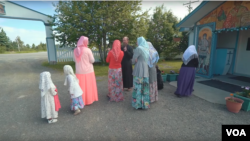
The land is too home to a community known every bit the Russian Erstwhile Believers. They came to Alaska from Russian federation nearly 50 years agone. They congenital a hamlet on Alaska'south Kenai Peninsula. The village is called Nikolaevsk.
Splitting from Russia
The Old Believers carve up from the Russian Orthodox Church in the 17th century. They separated to protest changes in the church imposed by the patriarch. The patriarch is the highest-ranking Bishop in the Russian Orthodox religion.
Later, political changes in Russia forced many of them to flee the state.
Mother Irina Fefelova is a member of the Former Believers church building. She is the widow of Kondrat Fefelov, an Onetime Believers priest.
She said the introduction of communism in Russia made it difficult for the One-time Believers to go along their traditions and lifestyle.
"With the inflow of communism, at get-go it was fine, but and so they but started coming to the huts and taking everything. Our people were used to having big families, the same as nosotros do now. Simply, you need to feed the kids – and they'd simply come up in and everything…and people had kids, mothers were crying – how we are supposed to feed the kids? And they go: "Throw the kids to the dogs, they'll eat them..."
At the time, Quondam Believers feared arrest. Many left Russian federation and crossed the border into China. Fefelova herself was born in Prc.
"We lived there for a while. And then life turned bad again with communists. Our parents escaped from communists – ran from Russia to Communist china, and and then we left China for the aforementioned reason."
Fefelova's family unit then went to Brazil. Later, they moved to the northwestern U.S. state of Oregon.
Some members of the One-time Believers settled in Oregon. Others, like Fefelova, continued on to Alaska. At that time, the Fefelova family already had seven kids. Four more were built-in in Alaska.
For Mother Irina, Alaska was a skilful place to call home.
Keeping their traditions
In Alaska, the Old Believers still pray in an ancient language chosen Sometime Church Slavonic. The older generations speak Russian. But, Fefelova says the younger generation prefers English.
"Our kids speak Russian well, nosotros spoke skillful Russian in the family. But their kids practise not speak Russian – they come to the grandma, and can't tell me, what they need. It'southward difficult. It'due south such a pity for the grandchildren. Now, when they end praying, Father starts reading them stories – all in American. Because the kids…don't sympathise a discussion."
Today, nearly 300 people live in Nikolaevsk. The men in the village earn money past line-fishing, and sometimes by building fishing boats. The village was one time famous for these boats.
Denis Fefelov is the son of Mother Irina and Male parent Kondrat, the late priest.
"We've built over 100 boats… And at present the boats are barely worn out, they stay functional. Instead of ordering new ones, people just sell them on. But nosotros nevertheless build some…"
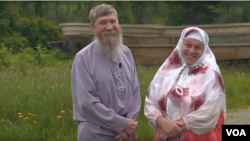
Fefelov was built-in in Brazil. He came to the U.South. with his family when he was 3 years erstwhile. He speaks fluent Russian and Old Church building Slavnoic, and teaches children church songs. He also watches the evening news in English, however, and considers himself an American.
Women in Nikolaevsk wear sarafan – a traditional Russian dress. They make the dresses themselves. The men have long beards and wear Russian shirts. Denis says people in nearby towns are used to seeing the Old Believers dressed in their traditional clothing.
"We are hither for 40 years. Maybe some tourists that visit think it'southward weird clothes. But the local people, they know us."
I'thousand Phil Dierking.
Natasha Mozgovaya wrote this story for VOA News. Phil Dierking adapted this story for VOA Learning English. Ashley Thompson was the editor.
Are in that location small communities from other countries where you lot are from? We want to hear from you. Write to us in the Comments Section or on our Facebook page.
______________________________________________________________
Words in This Story
cellar - due north. the function of a building that is entirely or partly below the ground
communism - northward. a fashion of organizing a society in which the regime owns the things that are used to make and transport products (such equally land, oil, factories, ships, etc.) and there is no privately owned holding .
patriarch - due north. an official of very high rank in the Orthodox Church
pity - due north. a strong feeling of sadness or sympathy for someone or something
Source: https://learningenglish.voanews.com/a/russian-culture-still-alive-in-rural-alaska/3977418.html
0 Response to "what is the name of the russian peninsula that is closest to alaska"
Post a Comment