Why Did Florence Enjoy a Flourishing of the Arts in the 15th Century
The Renaissance: The 'Rebirth' of science & civilization
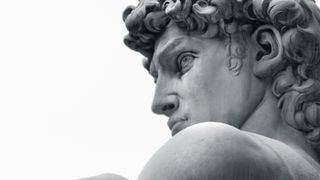
The Renaissance, which means "rebirth" in French, typically refers to a period in European history from A.D. 1400 to A.D. 1600. Many historians, however, assert that it started earlier or ended afterwards, depending on the country. It bridged the periods of the Centre Ages and mod history, and, depending on the country, overlaps with the Early Modern, Elizabethan and Restoration periods. The Renaissance is nearly closely associated with Italy, where it began in the 14th century, though countries such as Germany, England and France went through many of the same cultural changes and phenomena.
However, while the Renaissance brought near some positive changes for Europe, the geographical exploration that flourished during this time led to destruction for the people of the Western Hemisphere as European conquest and colonization brought plagues and slavery to the Ethnic people living there. In Africa, it also brought about the birth of the trans-Atlantic slave merchandise that saw Black people shipped from Africa to the Western Hemisphere to piece of work equally slaves on European colonies.
"Renaissance" comes from the French word for "rebirth." Co-ordinate to the Urban center University of New York at Brooklyn, intense interest in and learning most classical antiquity was "reborn" later on the Middle Ages, in which classical philosophy was largely ignored or forgotten. Renaissance thinkers considered the Middle Ages to take been a catamenia of cultural decline. They sought to revitalize their civilisation through re-emphasizing classical texts and philosophies. They expanded and interpreted them, creating their own style of fine art, philosophy and scientific enquiry. Some major developments of the Renaissance include astronomy, humanist philosophy, the printing press, vernacular language in writing, painting and sculpture technique, world exploration and, in the late Renaissance, Shakespeare'due south works.
What is the Renaissance?
Many historians, including U.G.-based historian and writer Robert Wilde, prefer to think of the Renaissance as primarily an intellectual and cultural motion rather than a historical flow. Interpreting the Renaissance as a time catamenia, though convenient for historians, "masks the long roots of the Renaissance," Wilde told Live Scientific discipline.
During this time, interest in classical antiquity and philosophy grew, with some Renaissance thinkers using it as a way to revitalize their civilization. They expanded and interpreted these Classical ideas, creating their own style of art, philosophy and scientific enquiry. Some major developments of the Renaissance include developments in astronomy, humanist philosophy, the press press, vernacular linguistic communication in writing, painting and sculpture technique, globe exploration and, in the late Renaissance, Shakespeare'south works.
The term Renaissance was not unremarkably used to refer to the flow until the 19th century, when Swiss historian Jacob Burckhardt popularized it in his classic, "The Culture of Renaissance Italia" (Dover Publications, 2016).
Historical development
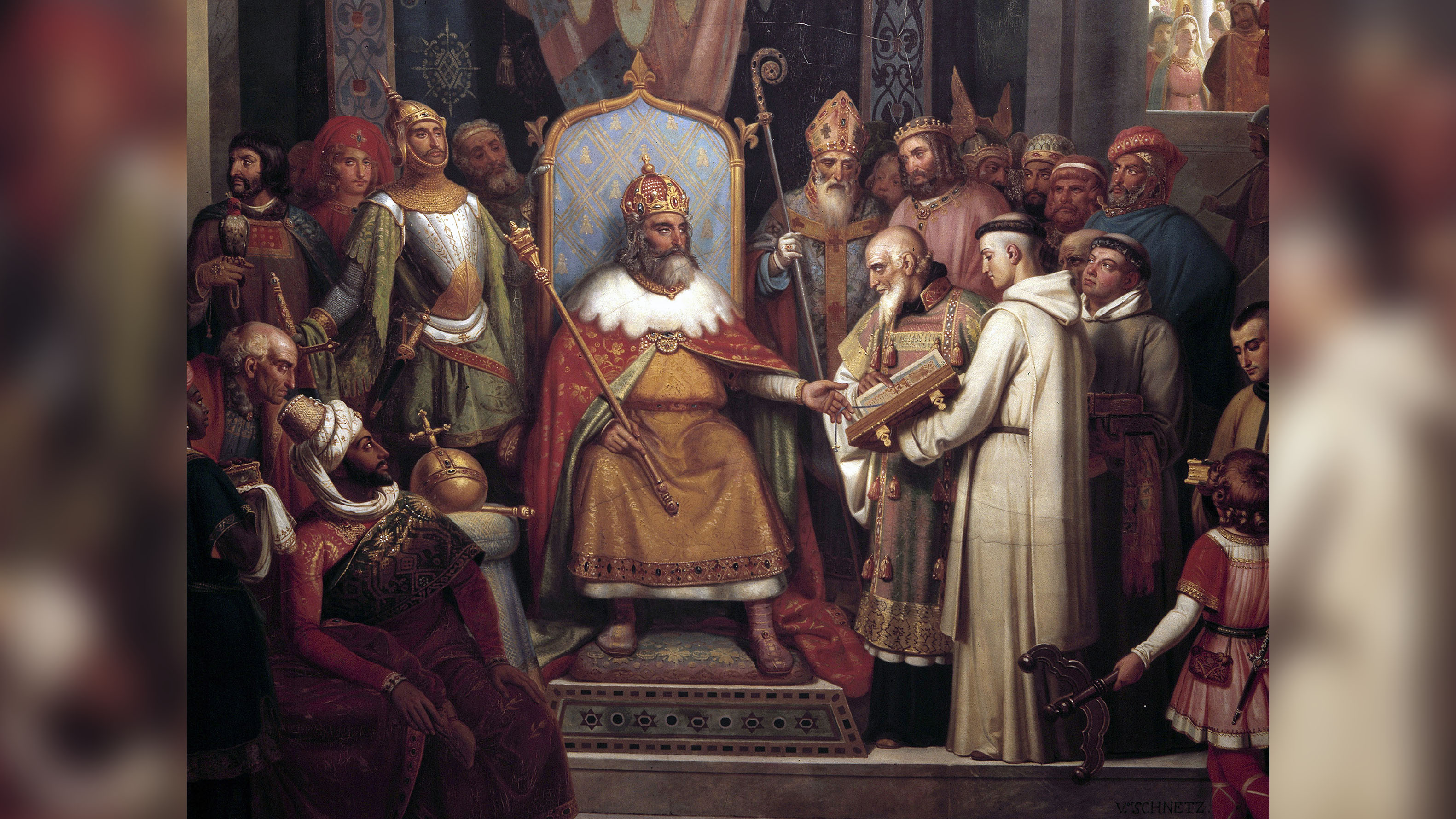
Contrary to popular belief, classical texts and knowledge never completely vanished from Europe during the Middle Ages. Charles Homer Haskins wrote in "The Renaissance of the Twelfth Century" (Harvard Academy Press, 1927) that at that place were 3 main periods that saw resurgences in the art and philosophy of antiquity: the Carolingian Renaissance, which occurred during the reign of Charlemagne, the kickoff emperor of the Holy Roman Empire (eighth and ninth centuries), the Ottonian Renaissance, which developed during the reigns of emperors Otto I, Otto II and Otto Three (10th century) and the 12th century Renaissance.
The 12th century Renaissance was especially influential on the later Renaissance, said Wilde. Europeans at the time studied on a larger calibration Classical Latin texts and Greek science and philosophy; they also established early versions of universities.
The Crusades played a role in ushering in the Renaissance, Philip Van Ness Myers wrote in "Medieval and Modernistic History" (Ginn & Company, 1902). While crusading, Europeans encountered advanced Middle Eastern civilizations, which had made strides in many cultural fields. Islamic countries kept many classical Greek and Roman texts that had been lost in Europe, and they were reintroduced through returning crusaders.
The fall of the Byzantine Empire at the hands of the Ottomans besides played a role. "When the Ottomans sacked Constantinople in 1453, many scholars fled to Europe, bringing classical texts with them," Susan Abernethy, a Colorado-based historian and writer, told Alive Science. "Disharmonize in Spain between the Moors and Christians too caused many academics to escape to other areas, particularly the Italian urban center-states of Florence, Padua and others. This created an temper for a revival in learning."
The Black Decease helped set the stage for the Renaissance, wrote Robert Due south. Gottfried in "The Blackness Decease" (Simon and Schuster, 2010). Deaths of many prominent officials caused social and political upheaval in Florence, where the Renaissance is considered to have begun. The Medici family moved to Florence in the wake of the plague and over the centuries produced business and political leaders also as four popes.
The Medici'due south, and many others, took advantage of opportunities for greater social mobility. Becoming patrons of artists was a pop way for such newly powerful families to demonstrate their wealth. Some historians likewise argue that the Black Death acquired people to question the church building's emphasis on the afterlife and focus more on the present moment, which is an chemical element of the Renaissance's humanist philosophy.
Many historians consider Florence to be the Renaissance'southward birthplace, though others widen that designation to all of Italy. From Italy, Renaissance thought, values and creative technique spread throughout Europe, according to Van Ness Myers. Military invasions in Italy helped spread ideas, while the end of the Hundred Years War between French republic and England allowed people to focus on things besides conflict.
The term "Renaissance Man," which is used today to depict someone who is talented in multiple fields, is derived from the Italian word "Uomo Universale," which means "universal human" and is often used to draw individuals similar Leonardo da Vinci who thrived in multiple fields like fine art and science.
Characteristics of the Renaissance
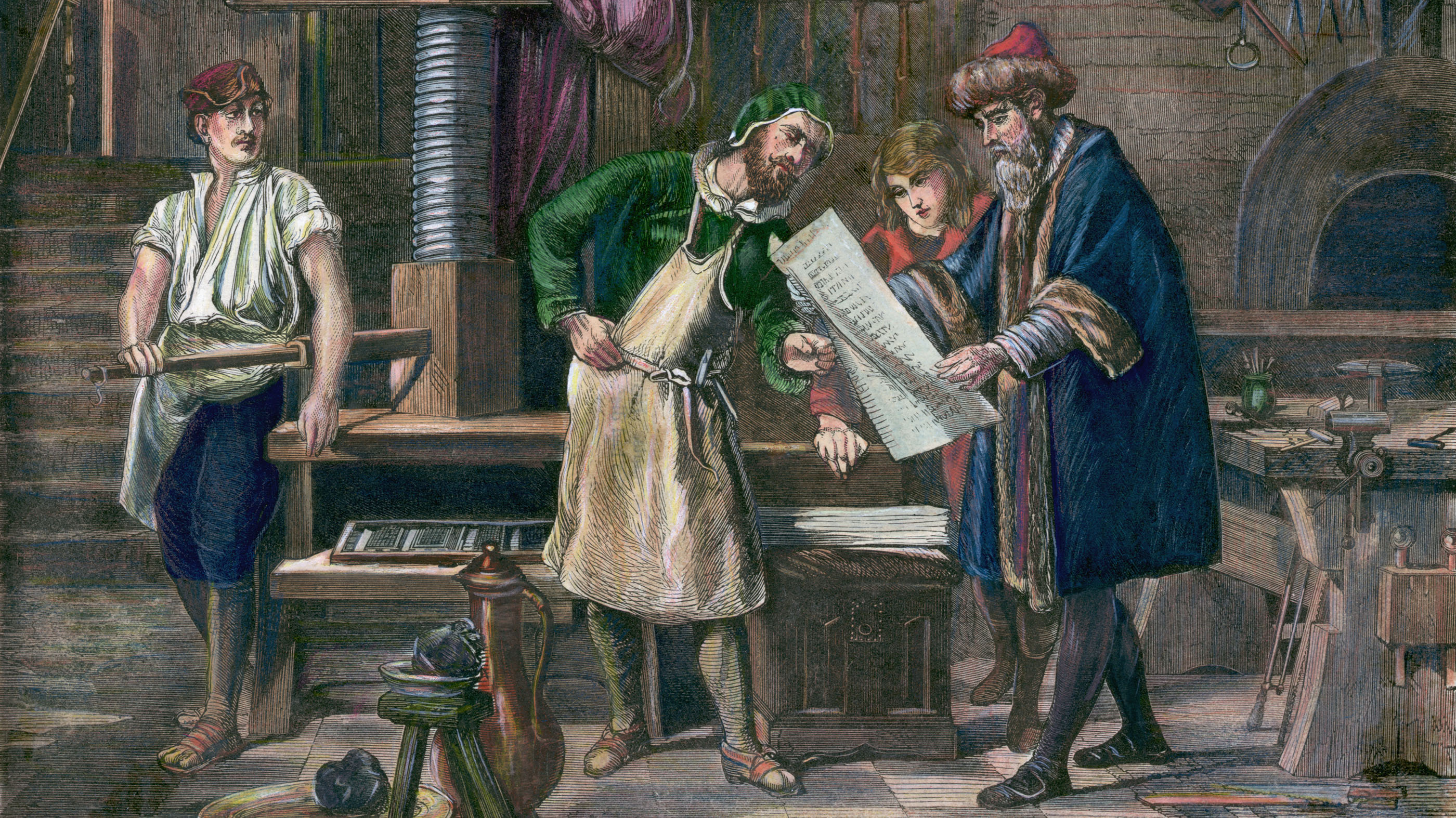
The development and growth of the printing press was maybe the most important technical achievement of the Renaissance. Johannes Gutenberg developed information technology in 1440, although the technology was used in China centuries before. It allowed Bibles, secular books, printed music and more to be fabricated in larger quantities and attain more people. "The need for perfect reproductions of texts and the renewed focus on studying them helped trigger 1 of the biggest discoveries in the whole of homo history: printing with movable type. For me, this is the easiest and single greatest development of the Renaissance and allowed modern culture to develop," said Wilde.
Intellectual movement
Wilde said one of the most pregnant changes that occurred during the Renaissance was the "evolution of Renaissance humanism as a method of thinking. … This new outlook underpinned and so much of the world then and now."
Renaissance humanism, Wilde said, involved "attempts by man to master nature rather than develop religious piety." Renaissance humanism looked to classical Greek and Roman texts to change contemporary thought, allowing for a new mindset after the Middle Ages. Renaissance readers understood these classical texts every bit focusing on human decisions, actions and creations, rather than unquestioningly following the rules set along by the Catholic Church building equally "God's plan."
Though many Renaissance humanists remained religious, they believed God gave humans opportunities, and information technology was humanity's duty to do the best and most moral beings. Renaissance humanism was an "ethical theory and practice that emphasized reason, scientific inquiry and human fulfillment in the natural world," said Abernethy.
Renaissance art
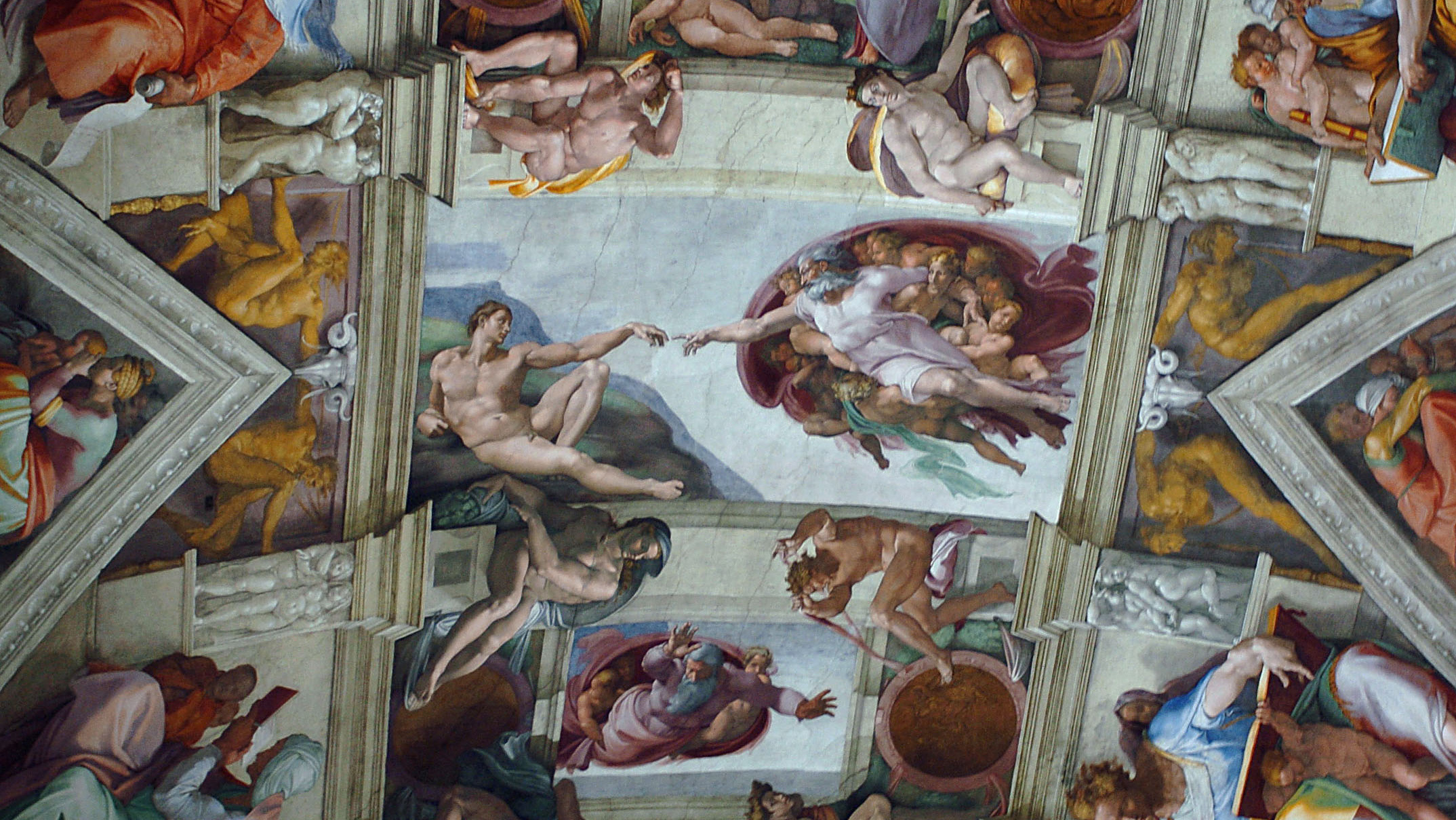
Renaissance art was heavily influenced past classical art, wrote Virginia Cox in "A Brusque History of the Italian Renaissance" (I.B. Tauris, 2015). Artists turned to Greek and Roman sculpture, painting and decorative arts for both inspiration and the fact that the techniques meshed with Renaissance humanist philosophy. Both classical and Renaissance fine art focused on human beauty and nature. People, even when in religious works, were depicted living life and showing emotion. Perspective, likewise equally light and shadow techniques improved; and paintings looked more three-dimensional and realistic.
Patrons fabricated it possible for successful Renaissance artists to work and develop new techniques. The Catholic Church commissioned almost artwork during the Middle Ages, and while information technology continued to do so during the Renaissance, wealthy individuals also became important patrons, according to Cox. The most famous patrons were the Medici family in Florence, who supported the arts for much of the 15th and 16th centuries. The Medici family unit supported artists such as Michelangelo, Botticelli, da Vinci and Raphael.
Florence was the initial epicenter of Renaissance art, simply past the terminate of the 15th century, Rome had overtaken it. Pope Leo X (a Medici) ambitiously filled the city with religious buildings and art. This period, from the 1490s to the 1520s, is known as the High Renaissance.
Renaissance music
As with fine art, musical innovations in the Renaissance were partly fabricated possible because patronage expanded beyond the Catholic Church. According to theMetropolitan Museum of Art, new technologies resulted in the invention of several new instruments, including the harpsichord and violin family unit. The printing press meant that sheet music could exist more widely disseminated.
Renaissance music was characterized by its humanist traits. Composers read classical treatises on music and aimed to create music that would bear on listeners emotionally. They began to incorporate lyrics more dramatically into compositions and considered music and poetry to be closely related, according to the Metropolitan Museum of Art.
Renaissance literature & theatre
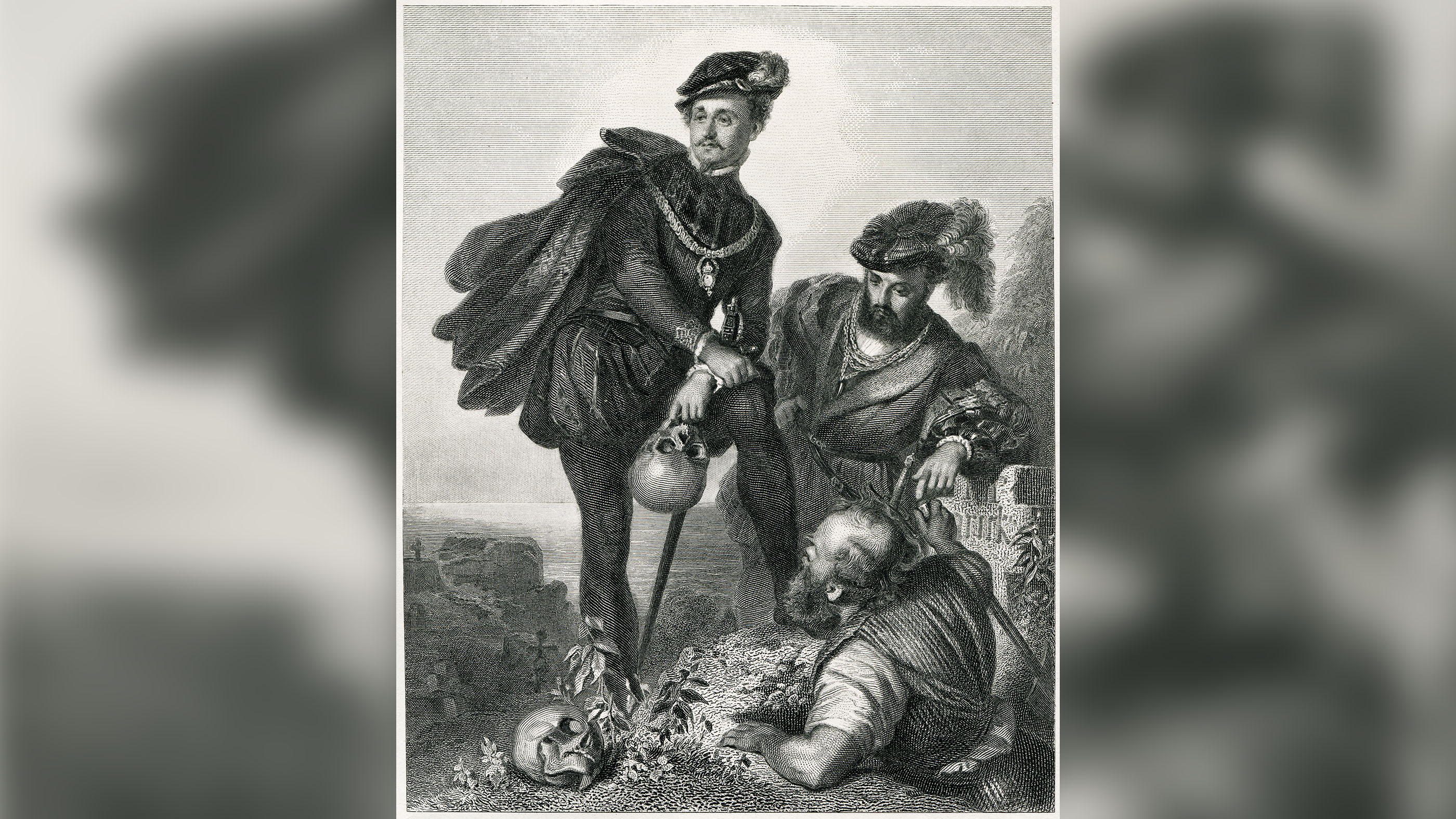
Renaissance literature, too, was characterized by humanist themes and a return to classical ethics of tragedy and comedy, according to the Brooklyn Higher English Department. Shakespeare's works, peculiarly "Hamlet," are good examples of this. Themes like human agency, life'south non-religious meanings and the truthful nature of homo are embraced, and Hamlet is an educated Renaissance homo.
The printing printing immune for pop plays to be published and re-dperformed around Europe and the globe. A play's popularity oftentimes determined whether publishers chose to impress the script, wrote Janet Clarke, an emeritus professor of Renaissance Literature at the University of Hull, U.Thou., in her volume "Shakespeare's Stage Traffic" (Cambridge University Press, 2014). "Publishers invested in plays that were popular every bit theatre traffic as much every bit they invested in the authors" wrote Hull.
Renaissance society & economics
The most prevalent societal modify during the Renaissance was the autumn of feudalism and the rise of a capitalist market economy, said Abernethy. Increased trade and the labor shortage caused by the Black Death gave rise to something of a center class. Workers could demand wages and adept living conditions, and then serfdom ended.
"Rulers began to realize they could maintain their power without the church building. There were no more than knights in service to the king and peasants in service to the lord of the estate," said Abernethy. Having money became more important than your allegiances.
This shift frustrated popes. The "Peace of Westphalia," a series of treaties signed in 1648, made it harder for the pope to interfere in European politics. Pope Innocent X responded that it was "null, void, invalid, iniquitous, unjust, damnable, reprobate, inane, and devoid of significant for all time."
Renaissance faith
Due to a number of factors — including the Black Decease, the rise in merchandise, the development of a center grade and the papacy's temporary move from Rome to Avignon (1309 to 1377) — the Catholic Church's influence was waning as the 15th century began. The re-emergence of classical texts and the rise in Renaissance humanism changed club's arroyo to religion and the authority of the papacy, said Abernethy. "[Humanism] created an atmosphere that gave rise to unlike movements and sects … Martin Luther stressed reform of the Cosmic Church, wanting to eliminate practices such as nepotism and the selling of indulgences," Abernethy said.
"Maybe most important, the invention of the printing press immune for the dissemination of the Bible in languages other than Latin," Abernethy continued. "Ordinary people were now able to read and learn the lessons of Scripture, leading to the Evangelical movement." These early Evangelicals emphasized the importance of the scriptures rather than the institutional power of the church and believed that conservancy was personal conversion rather than being determined by indulgences or building works of art or architecture.
The fracturing of Christians in western Europe into different groups led to conflicts, sometimes called the "wars of religion," that lasted for centuries in Europe. These conflicts sometimes led groups of people to go out Europe in hopes of fugitive persecution. I of these groups would become known as the Pilgrims when they came to Plymouth in 1620.
Renaissance geography
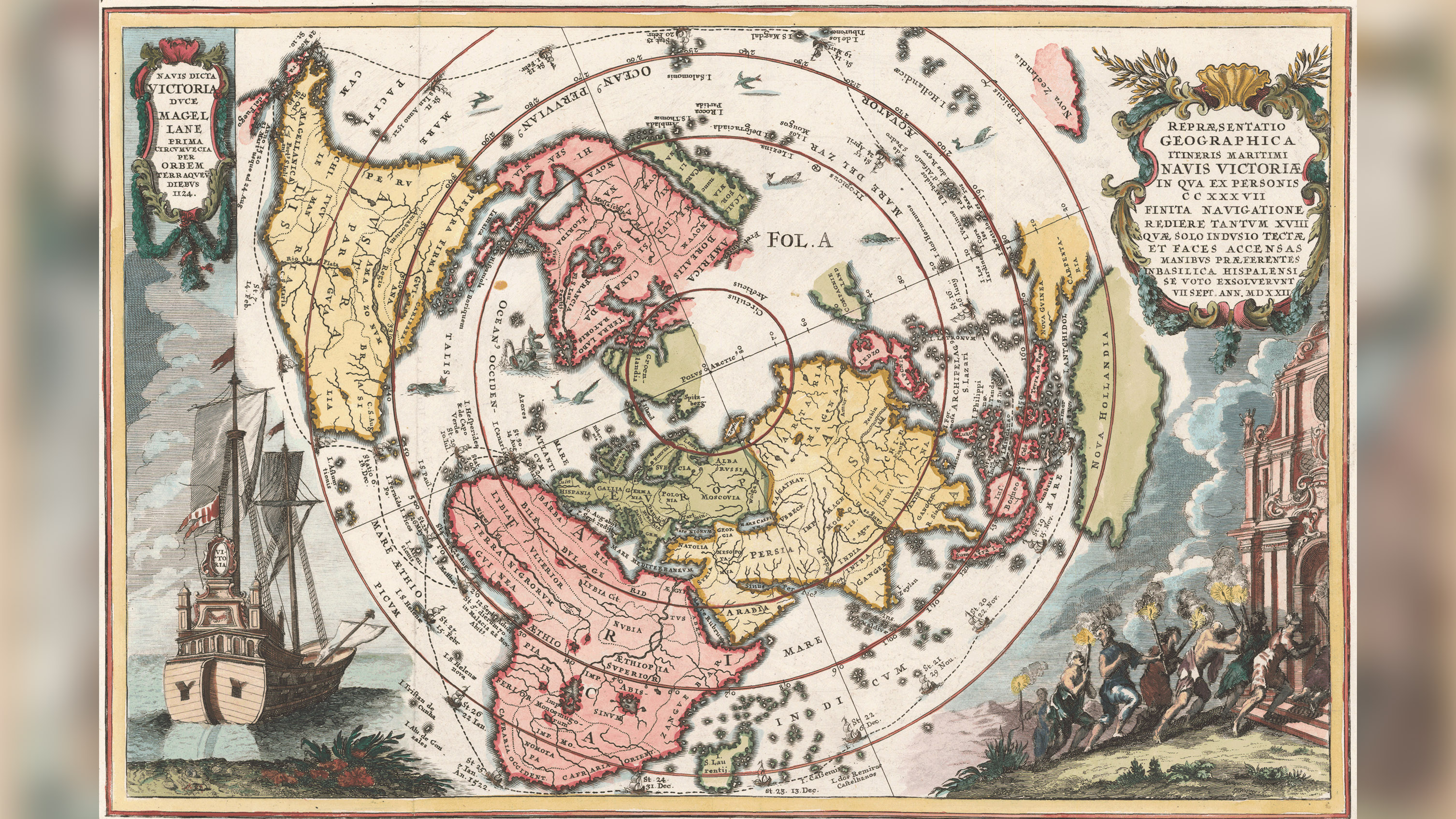
Thirsty to learn more about the world and eager to improve trade routes, explorers sailed off to chart new lands. Columbus "discovered" the New Globe in 1492, and Ferdinand Magellan became the starting time person to successfully circumnavigate the globe in the early 1500s.
For the people of the Western Hemisphere, the European exploration and colonization that occurred was disastrous. With petty or no immunity to the diseases Europeans brought over, the Indigenous population was ravaged by plagues, with death rates in some areas estimated every bit high as 90%. The Spanish conquered the Aztec and Inca Empires, forcing the native survivors to work as slaves.
European powers also explored more than of Africa, starting to conquer and colonize parts of the continent. Every bit their forcefulness in Africa grew, Europeans began to take people from Africa to work as slaves — in some cases sending them to piece of work on colonies in the Caribbean area and South America — this trans-Atlantic slave merchandise eventually expanding to what is now the United States.
Renaissance science
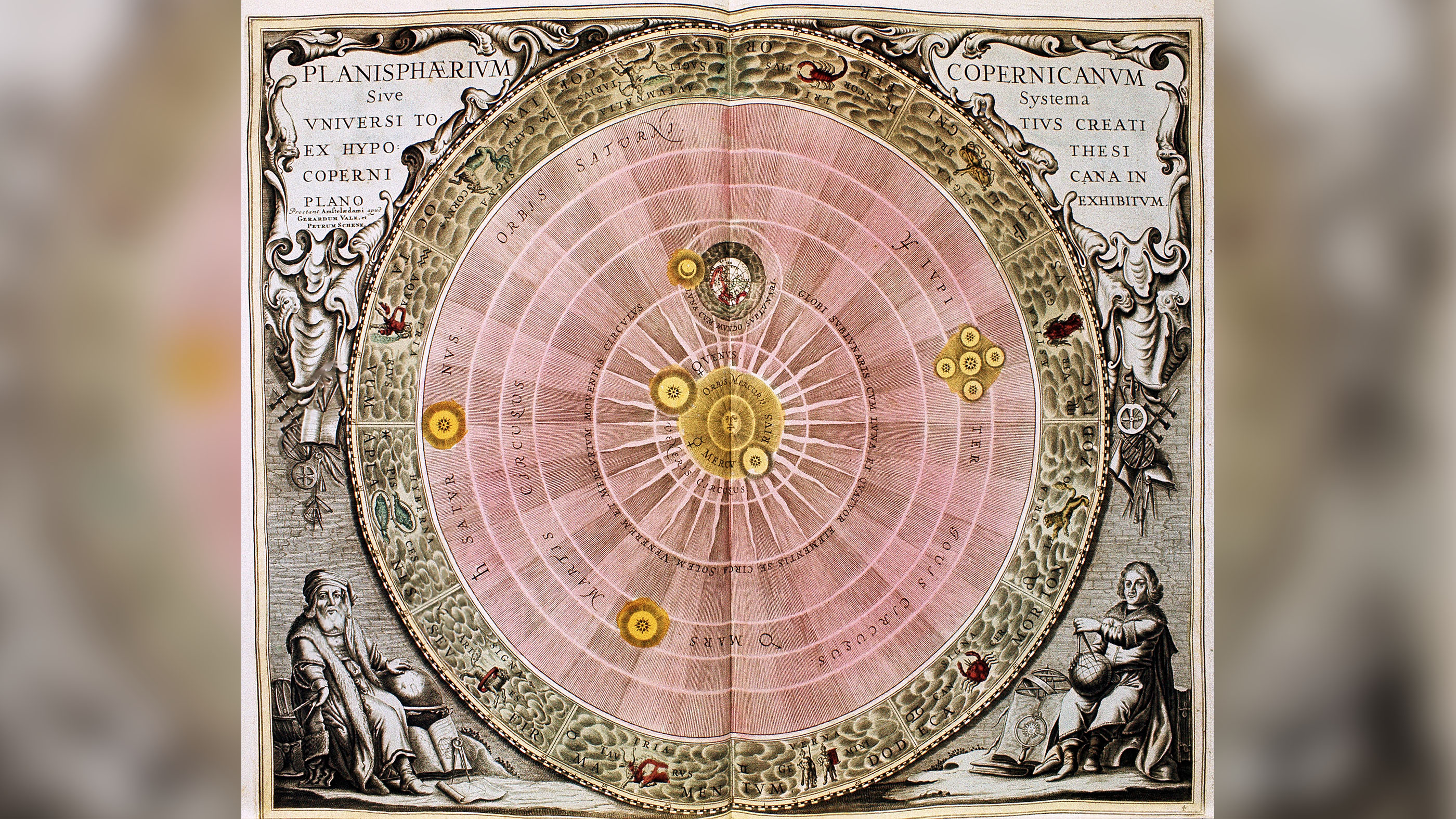
As scholars studied classical texts, they "resurrected the aboriginal Greek conventionalities that creation was constructed around perfect laws and reasoning," Abernethy said. "There was an escalation in the study of astronomy, beefcake and medicine, geography, alchemy, mathematics and architecture equally the ancients studied them."
1 of the major scientific discoveries of the Renaissance came from Polish mathematician and astronomerNicolaus Copernicus. In the 1530s, he published his theory of a heliocentric solar system. This places the sun, non the Globe, at the center of the solar system. It was a major breakthrough in the history of science, though the Catholic Church building banned the printing of Copernicus' volume.
Empiricism began to grab scientific thought. "Scientists were guided past experience and experiment and began to investigate the natural world through ascertainment," said Abernethy. "This was the first indication of a deviation between scientific discipline and religion. … They were existence recognized as 2 carve up fields, creating conflict betwixt the scientists and the church, and causing scientists to be persecuted," continued Abernethy. "Scientists found their work was suppressed or they were demonized equally charlatans and defendant of dabbling in witchcraft, and sometimes being imprisoned."
Galileo Galilei was a major Renaissance scientist persecuted for his scientific experiments. Galileo improved the telescope, discovered new angelic bodies and found back up for a heliocentric solar organisation. He conducted move experiments on pendulums and falling objects that paved the way for Isaac Newton's discoveries about gravity. The Catholic Church forced him to spend the last nine years of his life under house arrest.
Renaissance festival
While the term "Renaissance festival" typically refers to modern-solar day festivals that celebrate the art and civilization of the Renaissance, at that place were festivals that took place during the Renaissance itself.
For instance, Henri 2, who was king of France between 1547 and 1559, held festivals periodically throughout his reign that included stages of performers and lengthy parades. The festivals included the arrivals of the king into the urban center or town where the festival was being held, wrote Richard Cooper, an emeritus professor of French at the University of Oxford, in a paper published in the book "Court Festivals of the European Renaissance" (Taylor & Francis, 2017). Henri Ii sometimes held these festivals to make an important effect such as the coronation of his queen or a military victory, wrote Cooper.
How the Renaissance changed the world
"The Renaissance was a time of transition from the ancient world to the modern and provided the foundation for the birth of the Age of Enlightenment," said Abernethy. The developments in scientific discipline, art, philosophy and trade, as well as technological advancements like the printing press, left lasting impressions on society and ready the stage for many elements of our modern culture.
Nevertheless, while the Renaissance had some positive impact for Europe, it had devastating impacts for people of the Western Hemisphere, as plagues decimated Indigenous populations and the survivors often found themselves enslaved and under the dominion of European colonizers. This organisation of conquest, colonization and slavery also repeated itself in Africa as European power grew. Today, the ramifications of European colonization and slavery are still felt and hotly debated effectually the world.
Additional resources
—Learn more about the geniuses of the Renaissance, from da Vinci and Galileo to Descartes and Chaucer on this History Aqueduct page, with links to biographies of each.
—In this book past author Catherine Fet, kids volition larn well-nigh the Renaissance and its characters through tales of adventure.
—In this four-function BBC Boob tube series called "Renaissance Unchained," Waldemar Januszczak gives you lot a peek inside the more exciting aspects of the fourth dimension, from an episode on the gods and myths to one on a menstruation of war, confusion and … "darkness."
Bibliography
"The Culture of the Renaissance in Italy Paperback" by Jacob Burckhardt, Dover Publications, September 16, 2010. https://www.amazon.com/dp/0486475972
"The Renaissance of the Twelfth Century" by Charles Homer Haskins, Harvard Academy Press, 1927. https://www.amazon.com/dp/0674760751
"The Black Death: Natural and Human Disaster in Medieval Europe" by Robert Due south. Gottfried, Complimentary Press, March 1, 1985. https://world wide web.amazon.com/Black-Death-Natural-Disaster-Medieval/dp/0029123704
"A Brusk History of the Italian Renaissance" by Virginia Cox, I.B. Tauris, 2015. https://www.amazon.com/History-Italian-Renaissance-I-B-Tauris-Histories/dp/1784530778
"Music in the Renaissance" at the Metropolitan Museum of Art. https://www.metmuseum.org/toah/hd/renm/hd_renm.htm
Introduction to the Renaissance by the Brooklyn College English Department. http://bookish.brooklyn.cuny.edu/english/melani/cs6/ren.html
Philip Van Ness Myers wrote in "Medieval and Modern History" (Ginn & Visitor, 1902). https://www.amazon.com/Mediaeval-Modern-History-Philip-Centre/dp/B001R6ARQI
Source: https://www.livescience.com/55230-renaissance.html
0 Response to "Why Did Florence Enjoy a Flourishing of the Arts in the 15th Century"
Post a Comment